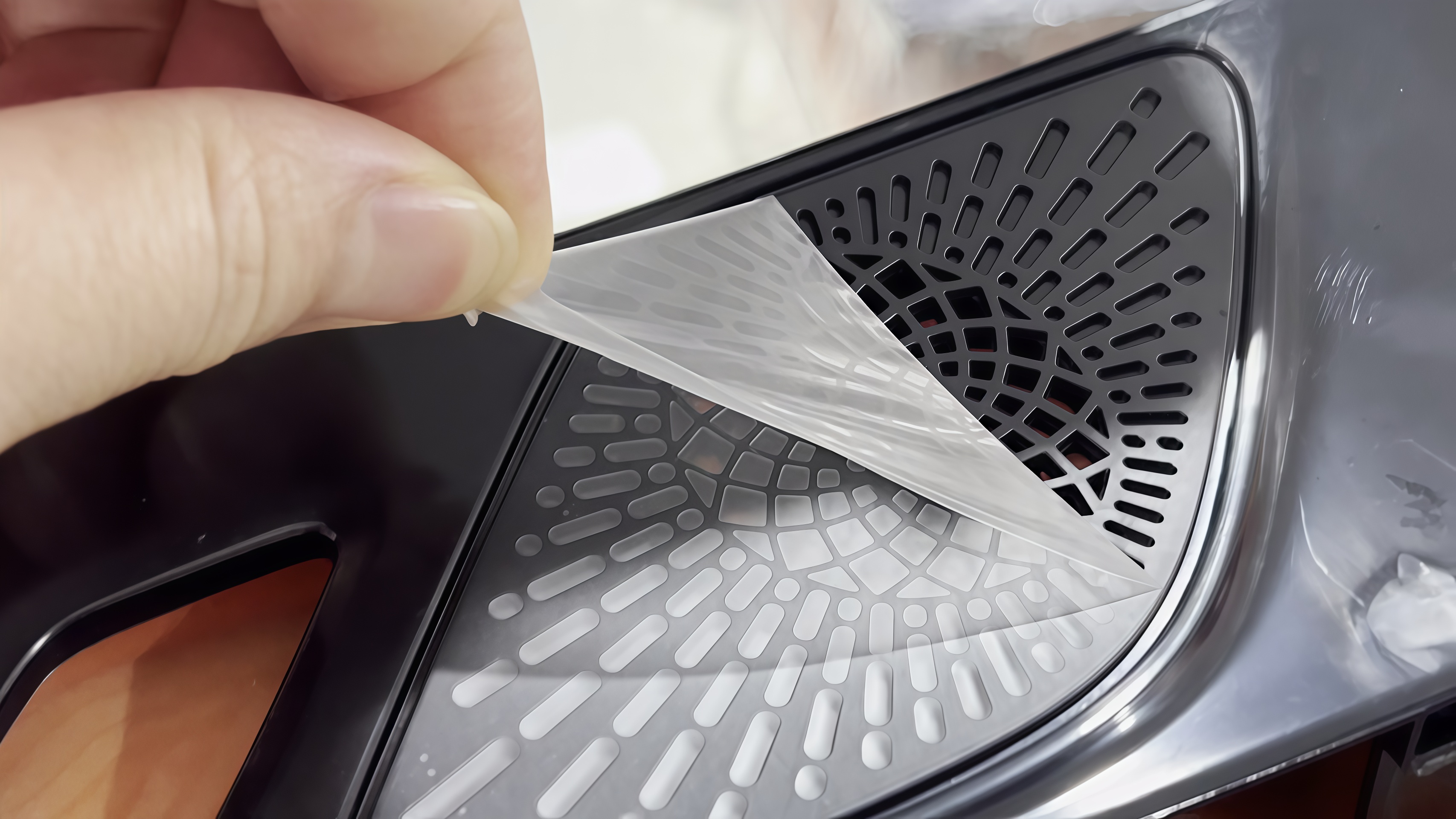
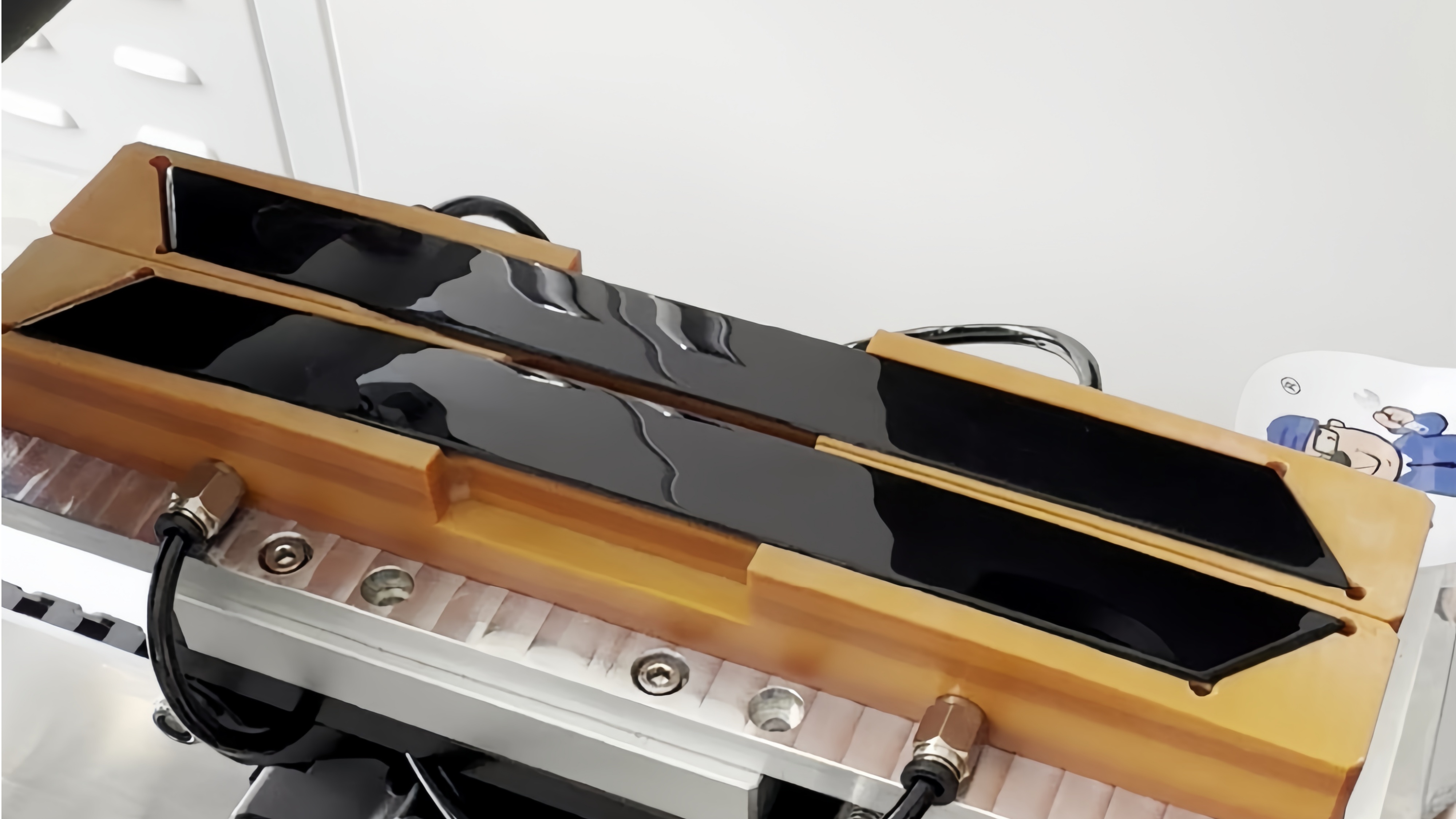
Why bubbles cannot hide under a clear lens
The lens is not a flat part. Its surface runs across a curve and the draft angle, and there are steps between the mounting holes and the clip seats, so the film has to bridge those rises before it is trimmed at the edge.
A flat press applies force on one plane. The head loads hardest at the high point of the curve, air under the low areas has no time to escape and is sealed in, and bubbles cluster along both sides of the curve and at the root of the flange.
Transparency amplifies all of it. A bubble that would pass on a structural part is a visible defect under transmitted light, and on a cluster with a display the backlight shows every dust print under the film. The appearance standard is already one grade tighter because the part is clear.
The second source is a pressure path that depends on feel. Hand application or a general purpose machine leaves the pressure and the direction to each pair of hands, so some parts in a batch hold and others trap air. Tighten the rejection standard and the batch is at risk.
The third source is cleanliness and scratch risk. Foreign matter under the film is not tolerated, PMMA and PC surfaces are soft, hand held film collects more floating dust, and every peel and re-apply carries a scratch that cannot be repaired.
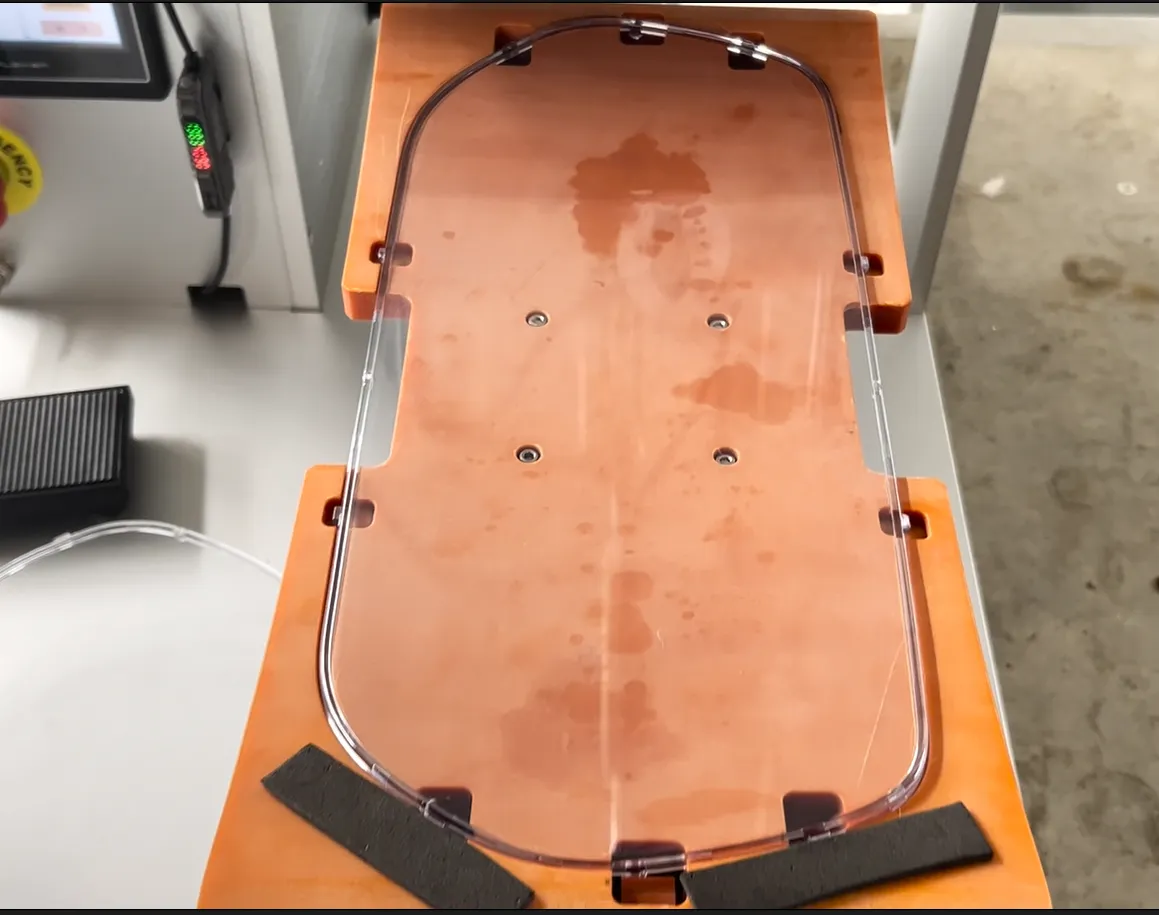
How each source of air gets closed
The DS-351B runs a fixed action cycle. A sensor detects the part in position, or a foot switch sends the start signal.
The bottom mold returns to its position and moves in sync with the film feed, the roller presses the protective film down and pushes air out, and the mold returns to its rest position for the next part. The film path and the pressure repeat from part to part and do not drift with a shift change.
Those three sources map onto the cycle directly. The film path is fixed, so the rolling direction drives air ahead of the bond line instead of sealing it at the low point of the curve. Pressure comes from the roller, applied section by section rather than in one downward stroke. Positioning is left to the machine, which removes the hand held film step and the dust it attracts.
The factory standard of no bubbles under the film refers to this parameter-locked film path. It is not a repair after the fact.
Positioning is locked by the fixture. The lens is clamped on its datum faces, application accuracy is plus or minus 0.5mm, and the film edge repeats part to part, so the edge on parts from the same batch lines up. Taken together, these three are the line between an instrument cluster lens film laminating machine and hand application.
Size window and fixture check
Start with the size window. The DS-351B runs film from 5 to 300mm long with a liner width of 20 to 260mm, and the developed size of most passenger car and commercial vehicle lenses falls inside that range. The direction of the curve decides the rolling path. Parts close to or beyond the window go to a trial before any custom boundary is discussed.
For other panel parts the same platform is quoted as an automotive instrument panel trim laminating machine, with a different fixture and program. The film path and the pressing mechanism do not change with the part family.
The fixture is built from the lens 3D data and positions the part on its datum faces. A new cluster model means a new fixture and new parameters, not a new machine. At about 75kg the desktop frame moves between stations without relaying the line.
|
|
|
|
|
|
|
|
|
|
|
|
|
|
400 to 800 pcs/h (machine action time, no manual handling)
|
|
|
|
|
|
|
|
|
|
|
DS-351B standard specifications. Special functions are customized per part and confirmed by the trial report.
Cycle time checked at loading
The 400 to 800 pieces per hour figure is machine action time and excludes manual handling. A cluster assembly line runs to a fixed takt, so the real cycle of the film station depends on the loading layout. The split in a semi-automatic setup is machine applies, operator loads, and one operator runs the station.
Run this instrument cluster lens film laminating machine at your own station for one hour and put the measured number into the production plan.
The DawnShine approach to clear lenses
DawnShine has built film application equipment for 15 years, holds more than 50 patents, produces under ISO 9001, and machines fixtures in its own CNC shop. For transparent cluster lenses the model we configure is the DS-351B semi-automatic roll laminator. It is built for automotive instrument panel work, and there are running references on both truck and passenger car clusters.
Each problem above maps onto a mechanism. Bubbles are held back by the synchronized film feed plus the roller, the film edge repeats through the fixture datum plus the 0.5mm accuracy, and the cycle is known from the fixed action loop plus a trial on your floor. The value is not on the specification sheet. It is in these three problems no longer happening.
Film coverage for this automotive instrument panel trim laminating machine includes PE, PVC, PET, OPP, UV, FPC and PO protective films as well as adhesive labels. For a clear lens we quote a high clarity protective film for transport and assembly protection. A transparent part is an appearance part, and its protection starts the moment it leaves the mold.
The process boundary, stated first
The film discussed here is surface protective film on the lens, for transport and assembly protection. It is not optical bonding between the cover and the display. Optical bonding with OCA involves optical adhesive and cleanroom conditions, is a separate process, and needs its own review.
If your part list also includes VHB tape, foam or clip assembly, those run on different fixtures and press heads and are quoted separately. Freeform lenses with very large curvature, and lenses beyond the 20 to 260mm liner window, go to a sample trial first. Customization is a fixture and program change on the same platform, not a different machine.
Send one lens for a trial
Whether this instrument cluster lens film laminating machine fits your part is settled with four items: the lens drawing or 3D data, the film roll you actually run, your cycle time target and your customer appearance acceptance standard. The physical part matters most of the four.
|
|
|
|
|
Whether the developed size falls inside the 5 to 300mm and 20 to 260mm window, and which rolling path the curve needs
|
|
|
Film and liner width verified on the real material, no substitute film on a clear part
|
|
|
A number taken from your assembly line takt, rechecked with a one hour run on the machine
|
Customer appearance standard
|
Transmitted and backlit inspection conditions brought into the trial, and the report recorded to the same standard
|
The trial runs with your film and your cycle target. The report records four results: bubbles and dust under transmitted and backlit inspection, film edge offset range, measured application accuracy and cycle time per part. Each one maps to an acceptance step on your line.
Contact DawnShine to book a clear lens trial, or ask for a quote on the DS-351B roll lamination setup.
About DawnShine
DawnShine (Dongguan DawnShine Precision Machinery Co., Ltd.) is based in Dongguan, Guangdong, with 15 years in film application equipment, more than 50 patents, ISO 9001 certification and an in house CNC shop. One selection rule: the model follows your part, your film and your acceptance standard, not a catalogue.
Frequently asked questions
Can a flat laminating machine with a fixture handle a clear lens?
A fixture solves positioning, not the film path. A flat press seals air at the low point of the curve, and bubble positions follow the curvature of the lens. Synchronized film feed plus roller pressure is what lets film follow a curved surface, and that comes from machine structure rather than a fixture.
How is zero bubbles defined here?
It means air is driven out along the rolling direction and not sealed at the low point of the curve, once the film path and the pressure are fixed as process parameters. A clear part is inspected under transmitted and backlit conditions, and the boundary is set in a trial with your curvature, your film and your clean environment.
PMMA and PC scratch easily. What protects the surface?
Positioning and pressing are done by the fixture and the machine, which reduces hand held film. Peel and re-apply is the main source of scratches, so getting it right in one pass is the best protection. The film is selected for transparent plastic surfaces and confirmed in the trial.
What if the liner width is not enough?
The DS-351B covers a liner width of 20 to 260mm and a film length of 5 to 300mm. Parts close to or beyond that window go to a sample trial first. Customization is assessed on the same platform after curvature following and edge quality are measured, not by switching to another model.
Is this the same machine as an automotive instrument panel trim laminating machine?
It is the same platform. The lens fixture and program differ from a trim part, and the film and the acceptance standard are set per part. A trial with your own lens shows which configuration your panel family needs.
Contact Us:
Website: https://www.dsautomachine.com/
Email: deshangjingji@gmail.com



.jpg)
.jpg?imageView2/1/w/64/h/64/format/webp)