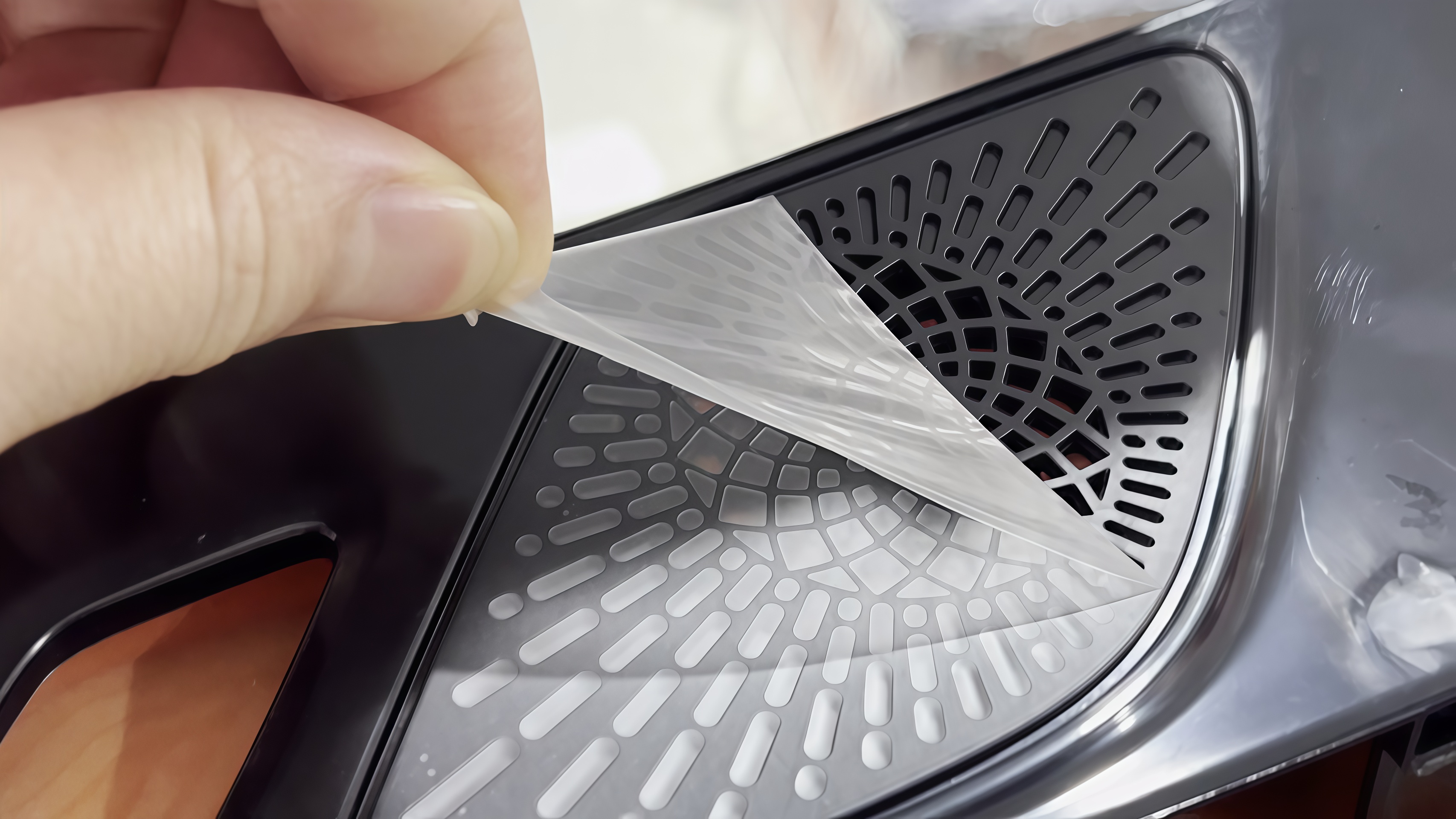
Where overhang and bubbles come from
Start with overhang. Film cut by hand, or supplied pre-cut, varies a millimeter or two from sheet to sheet. Placement then depends on feel, so the inset at the film edge wanders. An inset that is too wide leaves a strip of painted surface unprotected.
An edge pressed past the part boundary lifts and collects dust once the part is assembled. Exterior trim parts are appearance parts, and the customer rejects both states.
Then bubbles. Trim parts are not flat. Covers carry curvature and draft angles, and bezels carry a return flange around the edge. A flat press applies its force in one instant: pressure peaks at the high points of the curve while the air under the low points is sealed in before it can escape.
That is why bubbles gather along the flanks and at the root of the flange, at a different spot on every part.
Painted and high-gloss surfaces hide nothing under raking light. Worse, the two problems stack. When both placement and pressure depend on feel, the day shift and the night shift produce two different looking batches, and quality records stop matching the plan.
How the roll path closes off bubbles
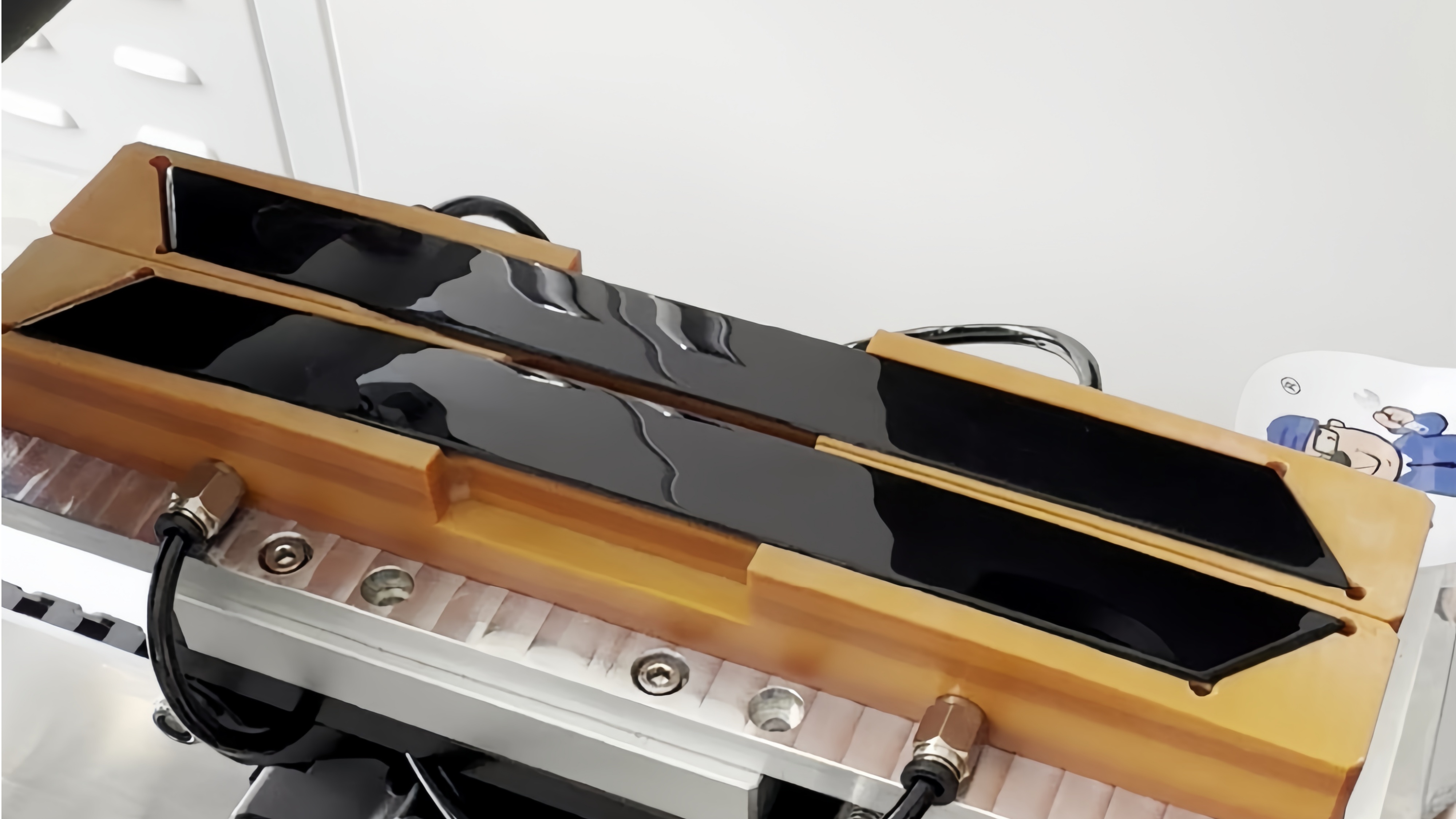
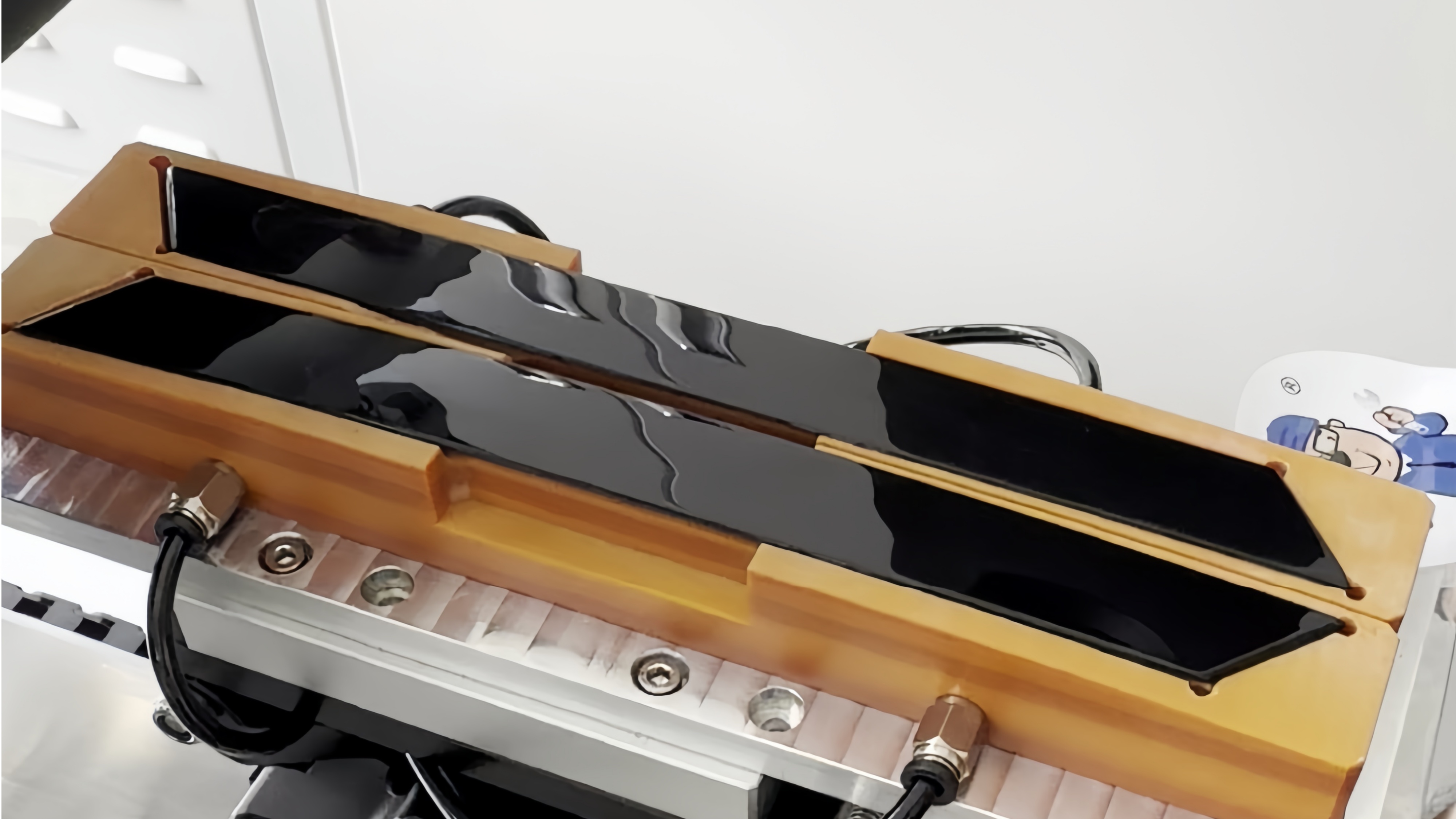
Roll lamination changes how pressure is applied. Film feeds out in sync from one end of the part, and the roller presses the film down section by section. Air is pushed ahead of the bond line and escapes instead of being sealed at the low points.
The laminating path is identical on every part, so the source of bubbles narrows from operator state to process parameters, and parameters that are set reproduce batch after batch.
The action cycle is fixed as well. A sensor detects the part in position, or a foot switch starts the cycle, the lower tool retracts and syncs with film feed, the roller presses the film and expels the air beneath it, then the lower tool returns to wait for the next part. Every part follows the same path with the same settings, on both shifts.
Positioning is locked by the fixture. Parts are clamped on datum surfaces, placement accuracy is ±0.2mm, and the machine reproduces the film edge position shift after shift. Trim sets delivered as pairs or kits line up their film edges because they start at the same point and roll under the same settings.
Lock film size first, then overhang stays closed
The other half of overhang is film size. The window on this automotive exterior trim laminating machine is fixed: film length 20~210mm and backing paper width 20~165mm on the DS-351. Inside that window, the cutting reference and the feed length are controlled by the equipment, and the inset is reproduced by the fixture, no longer dependent on how accurately each sheet was cut.
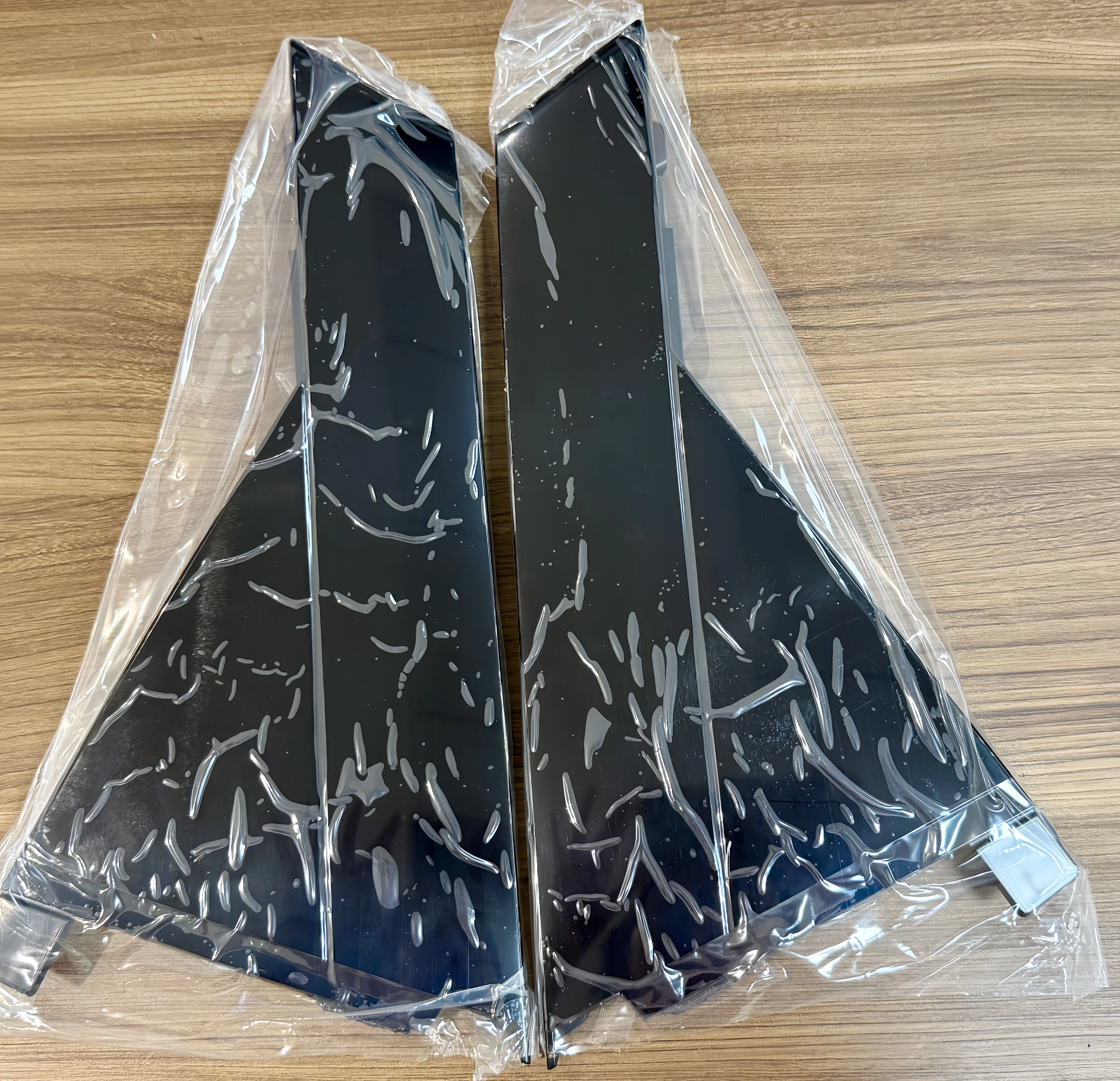
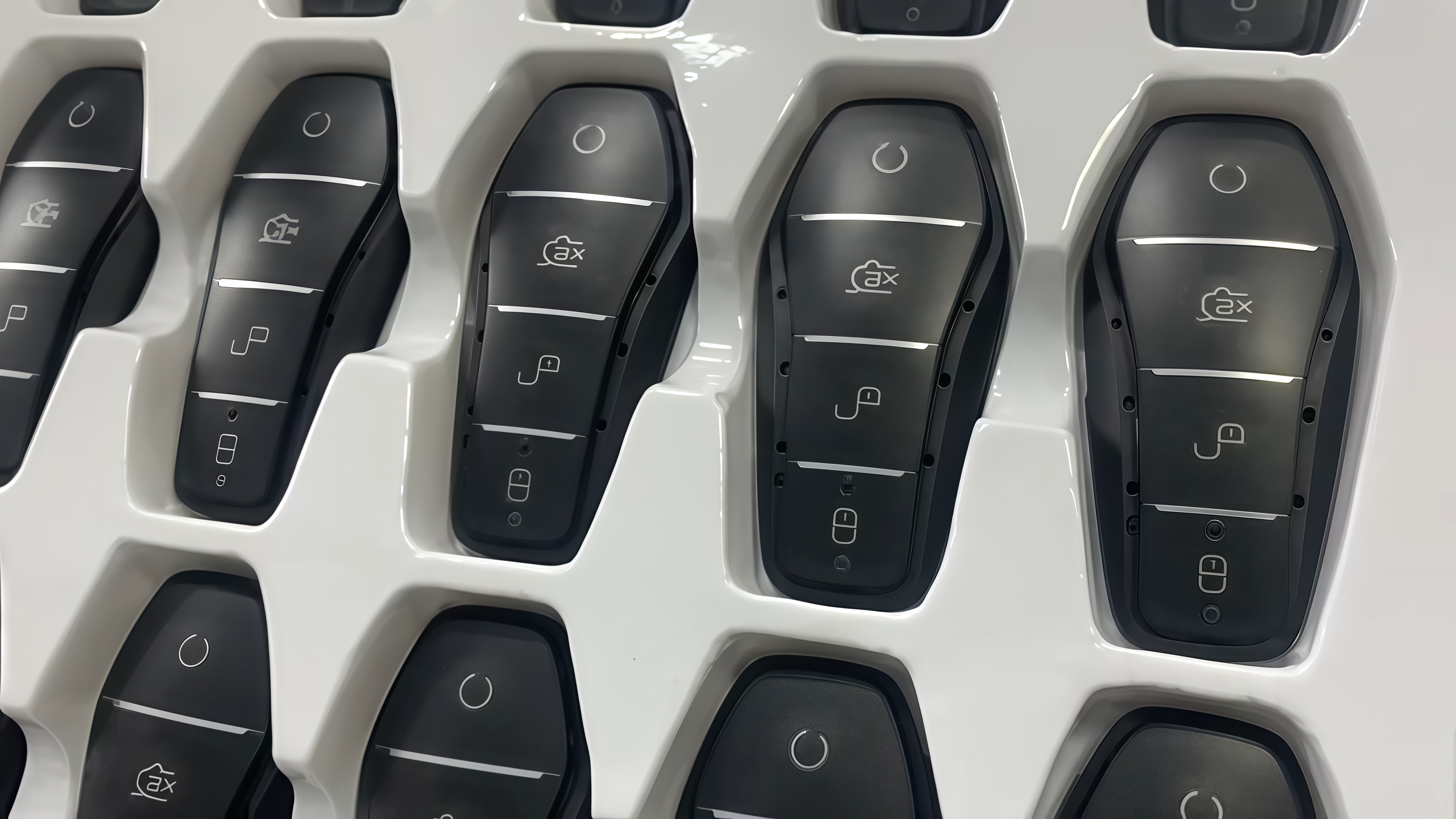
Most small exterior trim parts fit inside this window: pillar covers, bezels, emblem bases, gear indicators, key shells and audio fascias. Parts close to or beyond the window go to a trial before any custom build. Changing part models means changing fixture and parameters, not the machine; the desktop frame weighs about 70kg and moves between stations without rearranging the line.
|
|
|
|
|
|
|
|
|
|
|
|
|
|
600~1200 pcs/h (by operator skill and film size)
|
|
|
|
|
|
|
|
|
|
|
DS-351 standard model parameters. Special requirements can be customized per part, subject to the trial report.
Takt time is verified at your station
The 600~1200 pieces per hour figure depends on operator proficiency and film size; it is not a fixed value. Coating lines and post-molding lines run a fixed takt, and the real takt of the laminating station depends on the load and unload layout. Run the machine at your station for one hour and put the measured number into the production plan.
On this semi-automatic film laminating machine the division of work is machine laminating with manual loading. Model changes do not restart the takt discussion: swap the fixture and parameters, and one trial batch confirms the new takt.
The DawnShine solution for exterior trim
DawnShine has built laminating equipment for 15 years, holds more than 50 patents, produces under ISO 9001, and machines fixtures and tooling in its own CNC shop. For this direction, the automotive exterior trim laminating machine configuration is the DS-351 semi-automatic film laminating machine (roll type).
Map the defects back to mechanisms. Overhang stays closed through the cutting window and fixture positioning at ±0.2mm. Bubbles stay closed through section-by-section roll pressing. Batch consistency comes from the fixed action cycle. The value is not on the spec sheet; it is that these two rejects stop happening.
The machine takes PE, PVC, PET, OPP, UV, FPC and PO protective films plus self-adhesive labels, for protection during transport and assembly. Trim parts are appearance parts, and film protection starts the moment they leave the line.
Process boundaries stated up front
The DS-351 applies films and labels on flat surfaces, small arcs and small circumferences. Parts with deep freeform curvature, or beyond the 20~165mm backing width window, go to a sample trial first, and customization is discussed after the trial confirms the result. A custom build is a fixture and program change on the same platform, not a different machine.
If the part list also includes VHB tape, foam or snap fittings, those run on different fixtures and heads with separate quotations. This article covers surface protective film for transport and assembly protection, not optical bonding and not full vehicle wraps.
Send one part for a trial
Four items verify this automotive exterior trim laminating machine in one pass: the part drawing or 3D data, the film roll actually in use, the takt target, and the customer appearance acceptance standard. Among the four, the physical sample matters most.
|
|
|
|
|
Expanded size inside the 20~210mm / 20~165mm window; curvature direction confirms the roll path
|
|
|
Film material and backing width verified on the real roll, no substitute film
|
|
|
Give the coating or post-molding line number; one hour on the machine cross-checks it
|
Appearance acceptance standard
|
Raking-light conditions carried into the trial; report recorded to the same standard
|
The trial runs with your film and your takt target. The report records four items: film edge offset range, film surface under raking light, measured placement accuracy, and takt per part. Each item maps to one acceptance action on your line.
Contact DawnShine to book a trial on this exterior trim laminating machine, or request a quotation for the DS-351 roll solution.
About DawnShine
DawnShine (Dongguan DawnShine Precision Machinery Equipment Co., Ltd.) is based in Dongguan, Guangdong, with 15 years of film laminating equipment manufacturing, more than 50 patents, ISO 9001 certification and an in-house CNC machining workshop. One selection principle: the machine is decided by your part, your film and your acceptance criteria, not by a catalog.
Frequently asked questions
Can a positioning template solve overhang in manual laminating?
A template controls cutting, not pressure or air evacuation. Bubbles still form at the low points of a curve, and the film edge still drifts with operator feel. Closing overhang and bubbles together takes a fixed cutting window, a roll path and fixture positioning, which is set by the machine structure.
Will the roller mark the painted surface?
Roller pressure acts on the film surface while the part is supported by the fixture, and pressure settings are adjusted to the film and the paint. Bring your painted parts to the trial, verify them against your own acceptance conditions, and the report records the film surface state as measured.
Can larger trim strips or grilles be laminated?
Check the expanded size against the 20~210mm / 20~165mm window first. Parts close to or beyond the window go to a sample trial, and customization is assessed after the measured result, not by assumption.
Semi-automatic or automatic model?
On a semi-automatic film laminating machine the machine laminates and the operator loads, which suits exterior trim lines with frequent model changes. Lines with higher takt demands and concentrated models can then evaluate automatic loading. Validate the process window on the DS-351 first.
Website: https://www.dsautomachine.com/
Email: deshangjingji@gmail.com



.jpg?imageView2/1/w/64/h/64/format/webp)