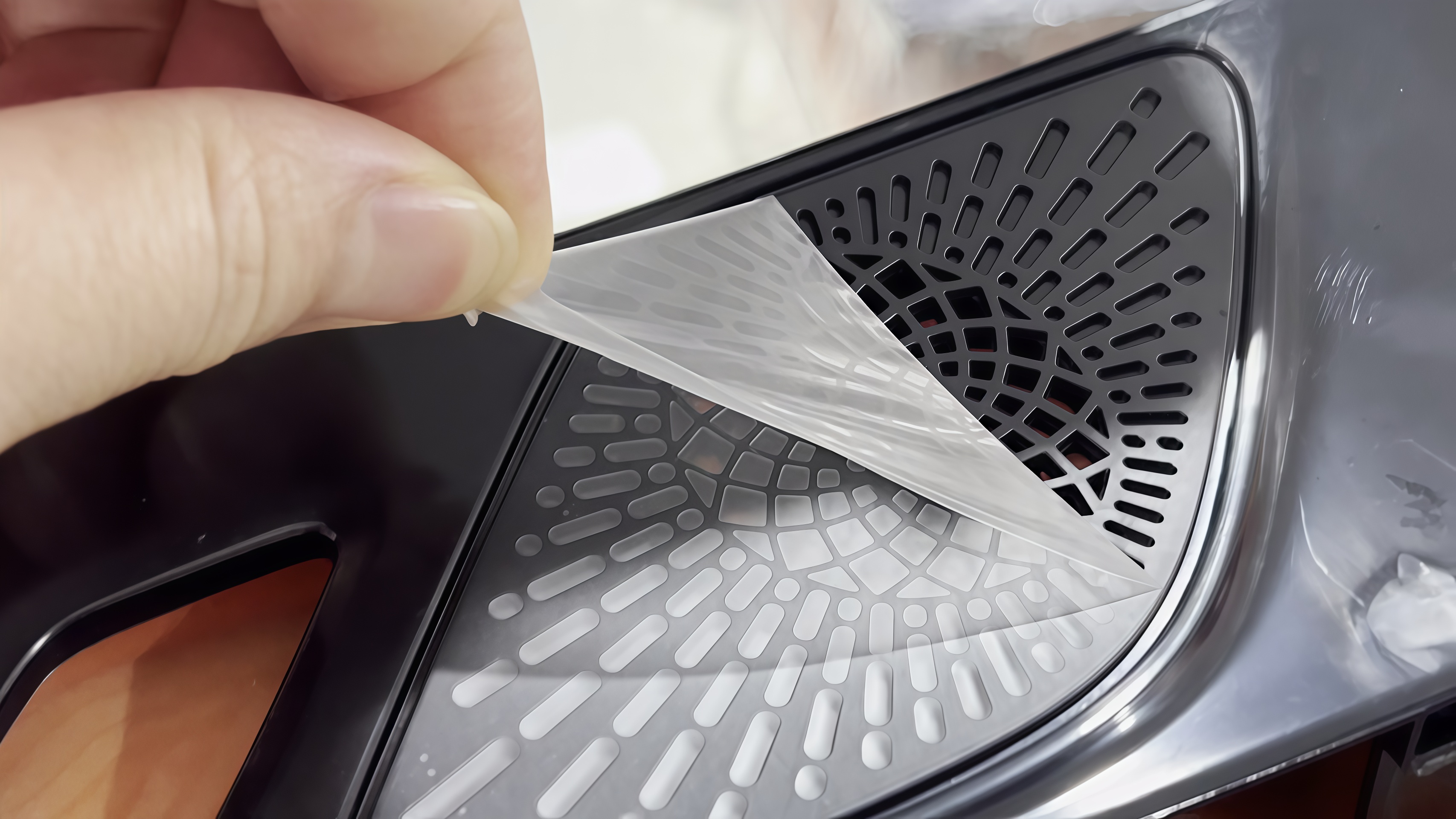
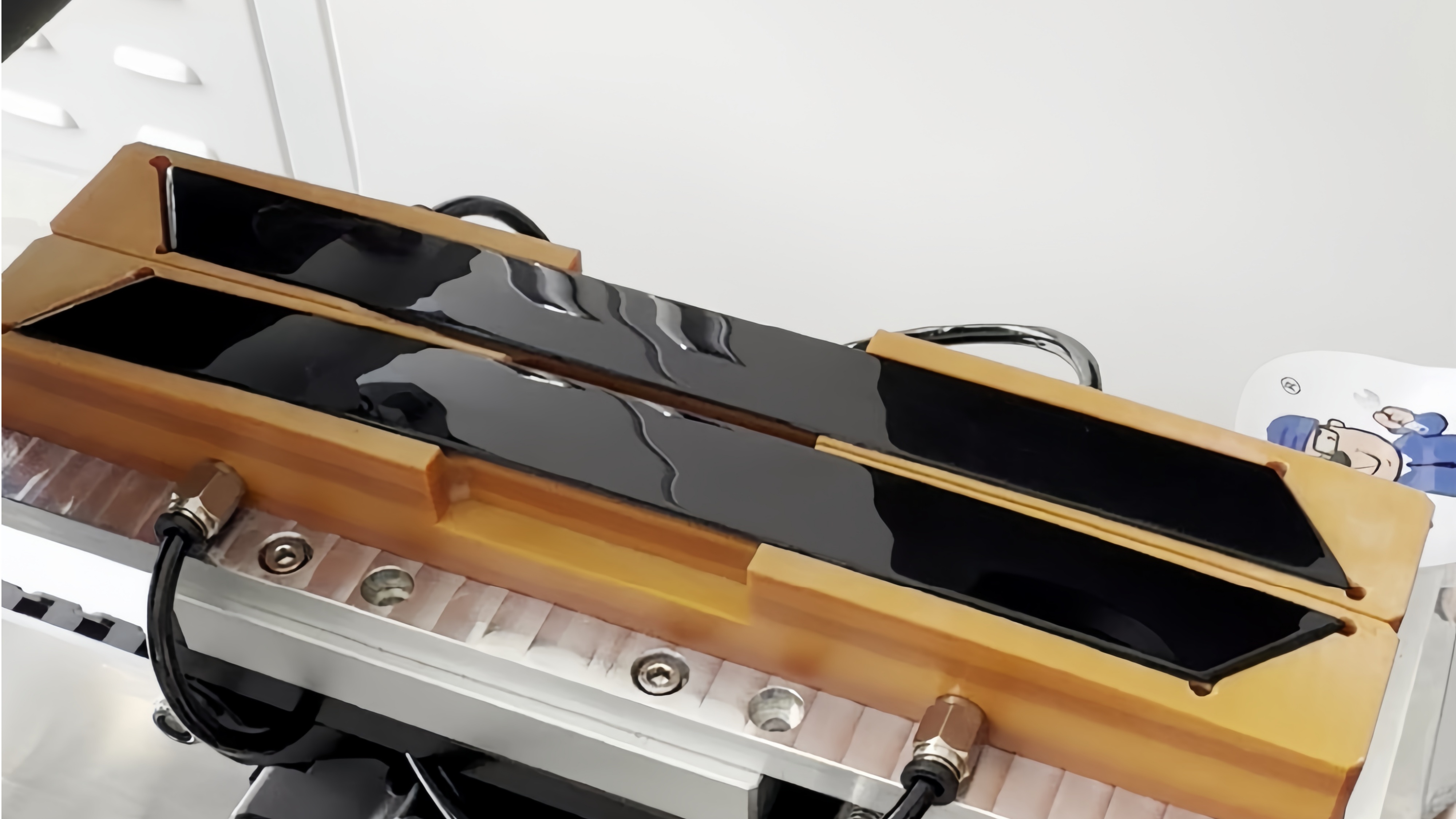
This article is written from the seat of a process and quality engineer in a molding plant. It separates where handle lamination actually breaks down, what a plastic part film laminating machine has to hold, and how a sample trial locks each of those variables down.
Gloss parts leave no room for a second attempt
The outside face of a door handle is what every occupant touches every day. The protective film is the last layer before assembly and shipping. A bad application is usually not a rework, it is scrap.
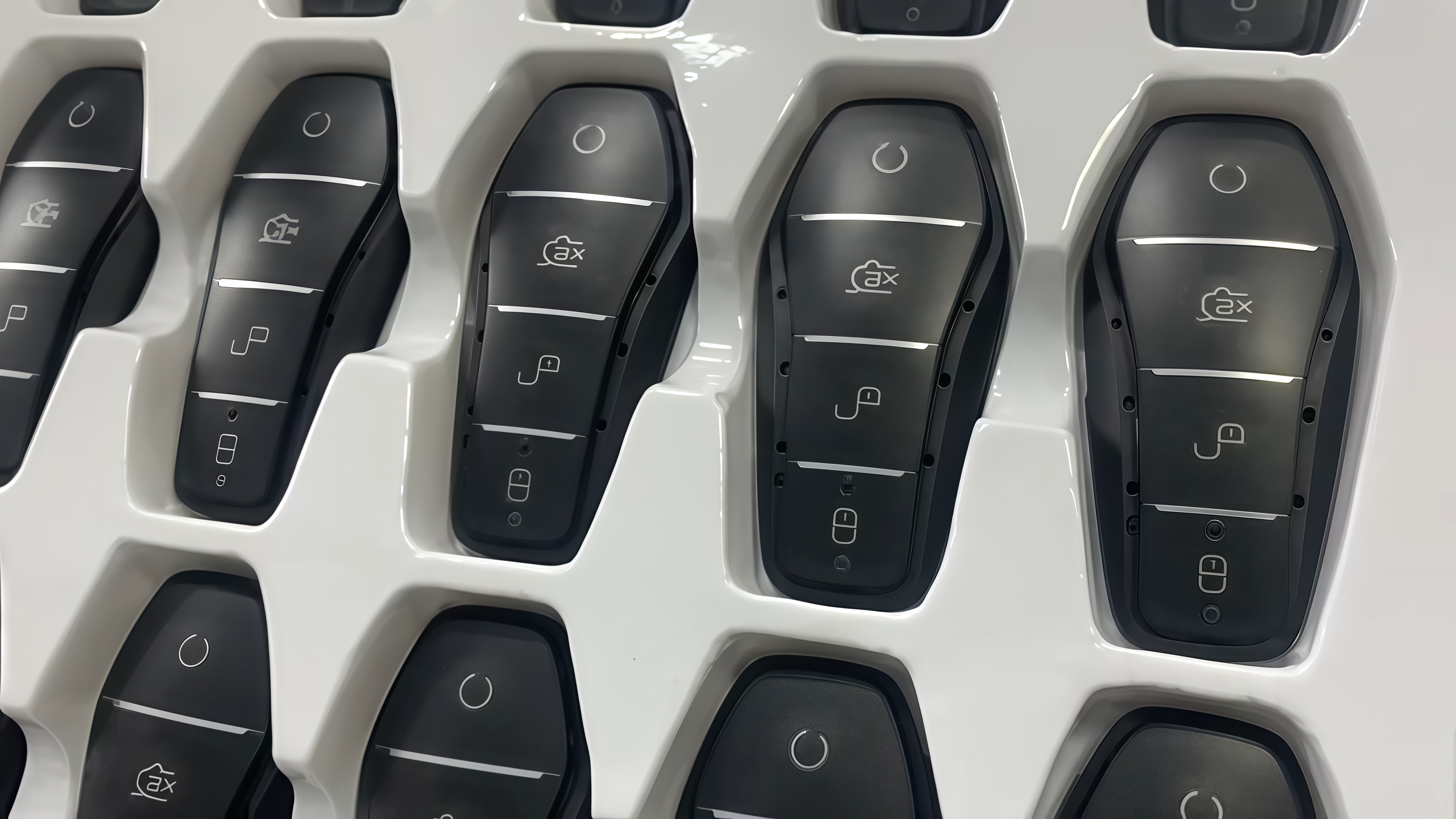
A gloss surface shows everything under raking light. Bubbles, wrinkles and fingerprints that pass on a matte molding are visible defects on a bright handle. The inspection standard is already written, so rejection is only a matter of time.
That is why the first question about an automotive door handle trim film application machine is not whether it can lay film down. It is whether it has a mechanism that stops appearance defects inside the machine.
Curves and drops: bubbles live in the press order
A handle is not a flat part. The body is a three dimensional form with draft faces, a radius transition and mounting feet, so the film path has to follow the shape.
The usual manual failure sits in the press order. Press the middle first and chase the air outwards, and air is sealed into the low side of the curve before the roller arrives. Position is set by feel, so no two parts in a batch match.
Roll application gives the order to the machine. The film starts at one end, the roller bonds it down in sections, and air is driven ahead of the bond line and out along the rolling direction instead of being trapped under the film. That is why a plastic part film laminating machine is judged on press sequence, not on pressure alone.
Large drops are the second obstacle. Between the grip face and the mounting foot the step is often tens of millimetres, so manual work needs constant pressure changes that a new operator cannot hold.
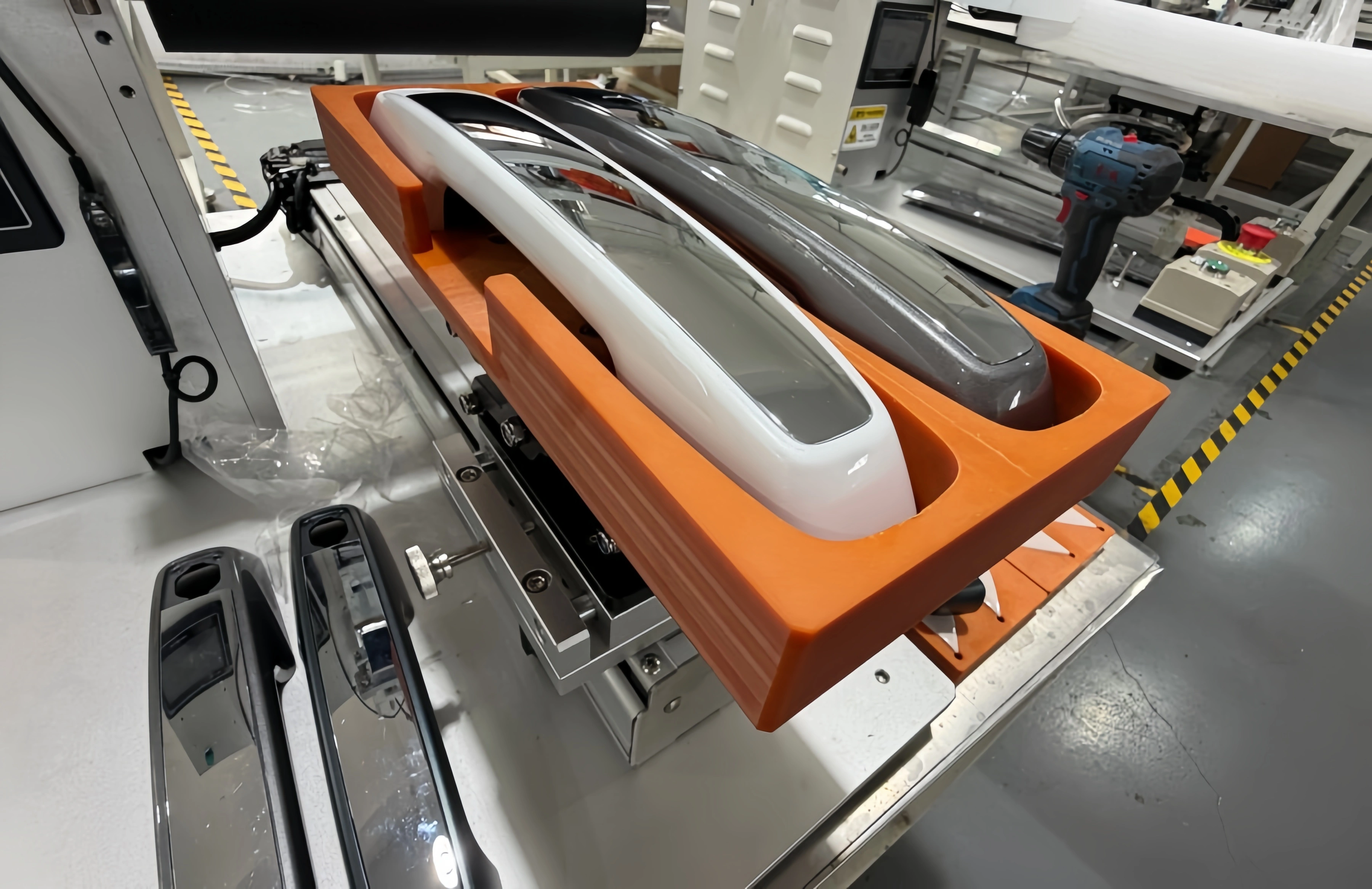
A desktop roll platform is specified for flat surfaces, small curves and small circumferential faces, which covers the main lamination face of most handles. Parts with a very large drop, or several faces in one pass, go to a trial first and the configuration is confirmed from the report.
Exposed and hidden handles, two film paths
Door handles now follow two design routes. A hidden door handle film laminating machine meets a flatter, longer part, while exposed handles stay closer to the classic curve, and the film problem changes with the route.
|
|
Exposed handle
|
Hidden handle
|
|
Geometry
|
Main curve with filleted root, regular outline
|
Longer and flatter, chamfered end, flush with the body
|
|
Film difficulty
|
Bubbles on the curve, film edge skew
|
Wide film length span, tight inset, film edge must stay out of the shut line
|
|
Machine requirement
|
Roll application on a small curve, fixture location
|
Enough film length coverage, application accuracy, pair consistency
|
An exposed door handle laminating machine and a hidden handle program share one platform. What changes is the fixture and the program, not the machine.
With a hidden door handle film laminating machine, the film length window is checked against the drawing first. DS-305A runs film from 20 to 200mm long with a liner width of 20 to 160mm, which covers exposed handles and most hidden handles. Extended handles beyond 200mm go to a trial before any custom boundary is confirmed.
Paired delivery: one misaligned side rejects the pair
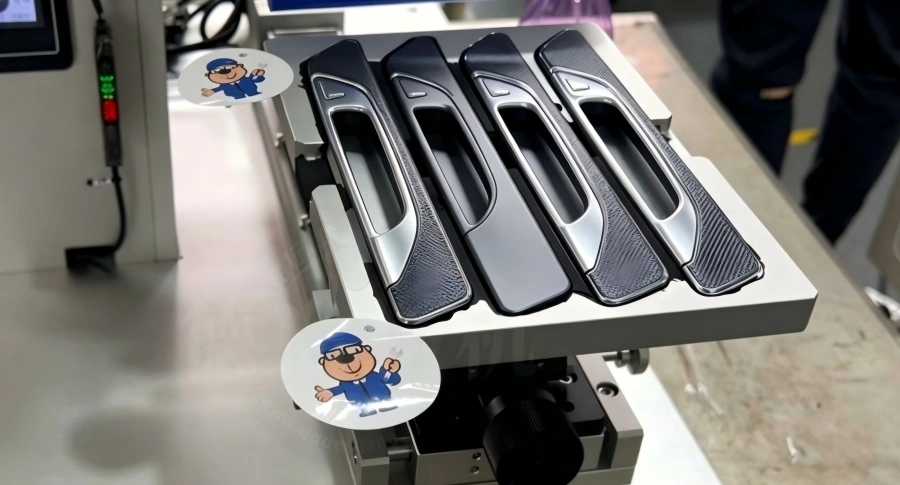
Handles ship in pairs and customers inspect in pairs. A perfect film on one side does not rescue a pair when the other side is off.
Under hand lamination the mismatch is close to certain: two films, two alignments, two operator rhythms.
Under machine application both sides come off the same fixture datum and the same parameter set. DS-305A holds plus or minus 0.2mm application accuracy, so position is reproduced by the machine and pair consistency is built at the source.
The same parameters also keep the film inset identical on both sides, which is what the pair inspection on the customer line actually measures.
Throughput is quoted at 600 to 1200 pieces per hour, depending on operator skill and film size, with the trial run as the final reference.
When cycle time floats, planning floats with it
The first three variables sit on the quality side. The fourth sits on planning. A molding machine cycles at a fixed rate, while hand lamination drifts with the person and the shift.
The result is a tray of unlaminated parts parked in front of the station. More waiting parts means more handling damage and more contamination, and the production plan gets harder to hold.
Machine application turns cycle time into a number you can measure. DS-305A runs the application stroke at a fixed rate, the operator only loads and unloads, and the measured output goes straight into the planning sheet.
A new handle number does not restart the cycle time discussion. The fixture and the program change, the application mechanism does not, and one pilot batch confirms the new output.
A typical selection route: from sample to configuration
Most handle plants arrive with a defined part and a capacity target. What they are missing is a lamination setup they can commit to, so the route is worth describing in full.
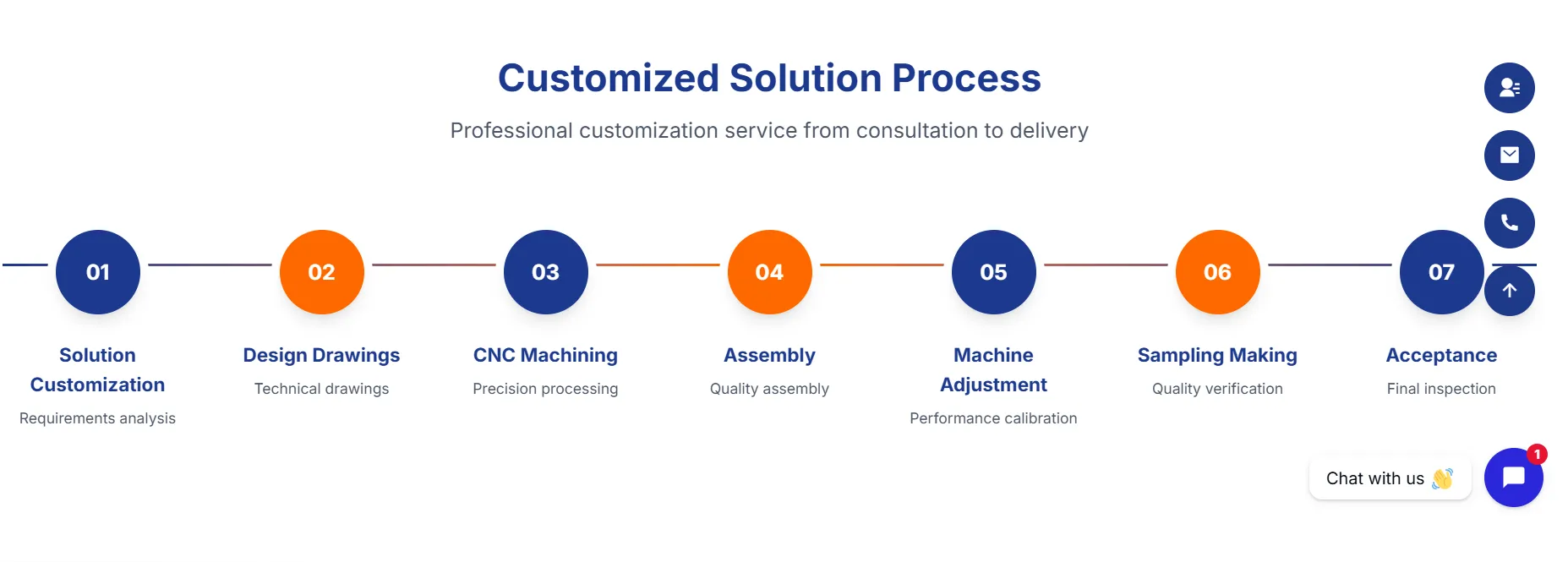
Send or bring four things to the DawnShine workshop: the part drawing, the film roll you actually run, the cycle time target and the customer's appearance acceptance criteria. Of the four, the physical sample matters most.
The trial run follows. The sample goes into a fixture, your film runs at your target rate, and the film edge offset, the surface under raking light, pair consistency and single part cycle time are recorded one by one.
The configuration comes out of that report. The process is not limited to one layout. Single station roll application is the baseline when cycle time is relaxed, a twin head layout can be evaluated when paired parts have to leave the machine as a pair, and multi station layouts apply four or more parts per cycle when volume climbs.
In form, DS-305A is a semi-automatic film laminating machine with manual loading. The application stroke is done by the machine and no line rebuild is needed around it.
The report then goes into the capital request. It contains numbers you can accept or reject, not adjectives, which makes it defensible to purchasing and to your customer.
What DawnShine quotes: DS-305A for handle parts
DawnShine has built film laminating equipment for 15 years, holds more than 50 patents, works to ISO 9001 and machines fixtures and tooling in its own CNC shop rather than outsourcing.
For the plastic part film laminating machine request behind this article, the model we quote for handle parts is the DS-305A semi-automatic high precision laminator. Each difficulty above maps to a mechanism:
|
Difficulty
|
Mechanism on DS-305A
|
|
Bubbles on a curve
|
Roll application, roller bonds in sections, air leaves along the rolling direction
|
|
Film edge offset and pair consistency
|
0.2mm application accuracy, one fixture datum and one parameter set reproduced part after part
|
|
Position set by feel
|
Sensor detection or foot pedal start, the application stroke is done by the machine
|
|
Cycle time and changeover
|
600 to 1200 pieces per hour measured into planning; desktop body, a new part means a new fixture
|
Standard model specification. Special requirements can be customized per part, subject to the trial report.
|
Item
|
Specification
|
|
Film types
|
PE, PVC, PET, OPP, UV, FPC, PO films and adhesive labels
|
|
Film size
|
Length 20 to 200mm, liner width 20 to 160mm
|
|
Application accuracy
|
Plus or minus 0.2mm
|
|
Output
|
600 to 1200 pieces per hour (depends on operator skill and film size, trial measured)
|
|
Power
|
220V/50Hz, 0.23kW
|
|
Air pressure
|
0.4 to 0.6MPa
|
|
Weight and size
|
About 75kg, 700 x 490 x 750mm, desktop
|
|
Part types
|
Flat, small curve and small circumferential surfaces
|
Desktop format at about 75kg. A new part number means a new fixture, not a second machine.
How the trial run works
A trial is not a formality. Bring four things and the report becomes usable:
● Bring the drawing. A 3D model or the critical section, with the shut line and the film inset line marked. Hidden handles need it most.
● Bring the film roll. Use the film your line runs. Film type and liner change the result a great deal.
● Bring the cycle time target. Minutes per part or per pair, used to check whether the configuration is enough.
● Bring the acceptance standard. Whatever your customer rejects on, the report is written against that measure.
The report carries four measurements: film edge offset range, surface record under raking light, pair consistency and measured cycle time. Each one matches an acceptance step on your line.
What changes on the line
● Rejects move from batch to part. Pair consistency is held by a machine mechanism, so a problem traces back to one part and one parameter set instead of a whole lot.
● New operators ramp faster. Alignment and pressure belong to the machine, so training shifts from experience transfer to process execution.
● The station moves with the layout. At about 75kg the desktop body follows your line layout, and a new part is a new fixture, not another machine.
● Cycle time enters the plan. Measured output goes into production planning, and delivery dates stop sitting on the edge.
Process boundaries, stated up front
The lamination discussed here is surface protective film, applied between the end of molding and assembly or shipping. It does not cover OCA optical bonding or any optical process.
If the bill of material also includes VHB tape, foam or clip assembly, those run on different fixtures and heads and are quoted as separate projects.
Parts outside the standard film window go to a trial before customization is discussed. Customization is a fixture and program change on the same platform, not a different machine.
Send your handle for a trial run
Exposed or hidden, the drawing does not tell you whether a machine fits. Four variables and one physical sample do.
If you are comparing a hidden door handle film laminating machine with an exposed handle setup, the same test applies. Send the handle parts, including the one with the largest curve, the film roll you run and your cycle time target.
We run them on DS-305A and report the film edge offset range, the surface record, pair consistency and the measured cycle time.
Contact DawnShine to book a door handle trial run, or request a quotation for a DS-305A handle lamination setup.
Frequently asked questions
What matters most on a hidden handle?
Film length window and film inset. A hidden handle is longer and flatter with a chamfered end, and the film edge must stay out of the shut line against the body. Check the length window on the drawing first, and trial any handle beyond 200mm before a custom boundary is confirmed.
How many parts per cycle?
DS-305A is a single station model, one part per cycle. Paired parts come off the same fixture datum and the same parameters one after the other, which is where pair consistency comes from. When volume needs more, a twin head or multi station layout is evaluated from the trial result.
What if no catalogue model matches?
Send samples for a trial. The process is not limited to one layout, so the configuration is built from your part and your capacity. That is the shortest route to a confirmed answer.
Which films can it run?
PE, PVC, PET, OPP, UV, FPC and PO protective films plus adhesive labels, for handling and assembly protection. OCA and optical bonding are outside the scope.



.JPG)
.jpg?imageView2/1/w/64/h/64/format/webp)