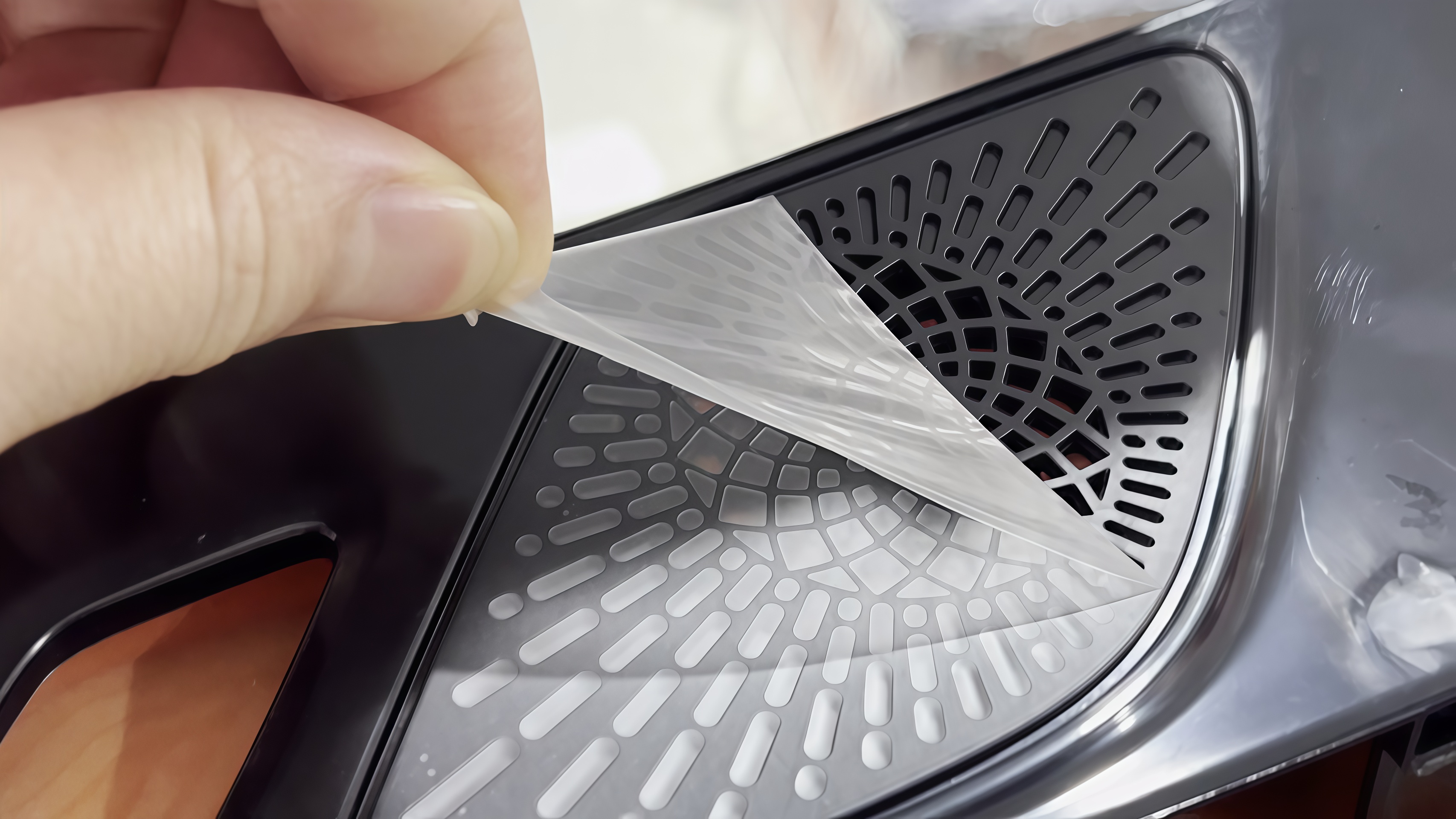
For production supervisors running the post-molding cell, this article goes through the four checks: where each one bites, how to verify it, and which specification line answers it.
Why Automotive Door Handle Parts Are Harder Than They Look
A door handle is a part the customer sees and touches every day, so it carries interior-grade cosmetic standards. Three things make it difficult to laminate.
● Glossy surfaces are judged at zero defects. Exposed handle covers come in piano black or chrome-bright finishes. One bubble under the film, or an edge step of half a millimetre, is visible on the assembly line. Cosmetic rejects are judged with a magnifier, not a caliper.
● Exposed and hidden handles are two geometries. Exposed handle covers are mostly flat or gently curved. Hidden, retractable handles are long slender parts with several curvature transitions, and the film has to bend around each one.
● Molded parts arrive with release agent and static. Release residue weakens adhesion and static pulls shop dust under the film. Hand application leaves both to the mood of the operator on shift.
So when you evaluate an injection-molded parts laminating machine, look past the parameter list and ask what mechanism answers each of these three problems.
The Four Production Checks
Check 1: The arc must be followed, which means rolling
A pressing head treats the film as one flat plane. On a curved cover it lands on the crown first and seals air into the low areas, and pressure will not remove it.
A roll-type head lays the film progressively from one edge, so the adhesive wets out as the roller travels and air is pushed ahead of the contact line instead of trapped beneath it.
Door handle covers carry only a gentle arc, but any transition is enough to give a flat press a bubble rate. This is the first hard standard for a door handle film laminating machine: roll application, with a roller diameter matched to your part.
How to check: send your most curved handle part, run it, and count bubbles under a raking light. Ask whether the roller was chosen for your arc or taken from stock.
Check 2: The film window must cover your deck
Handle projects run clear protective film in most cases, with white film for contrast or masking where the drawing calls for it. Materials range across PE, PVC, PET, OPP and UV films.
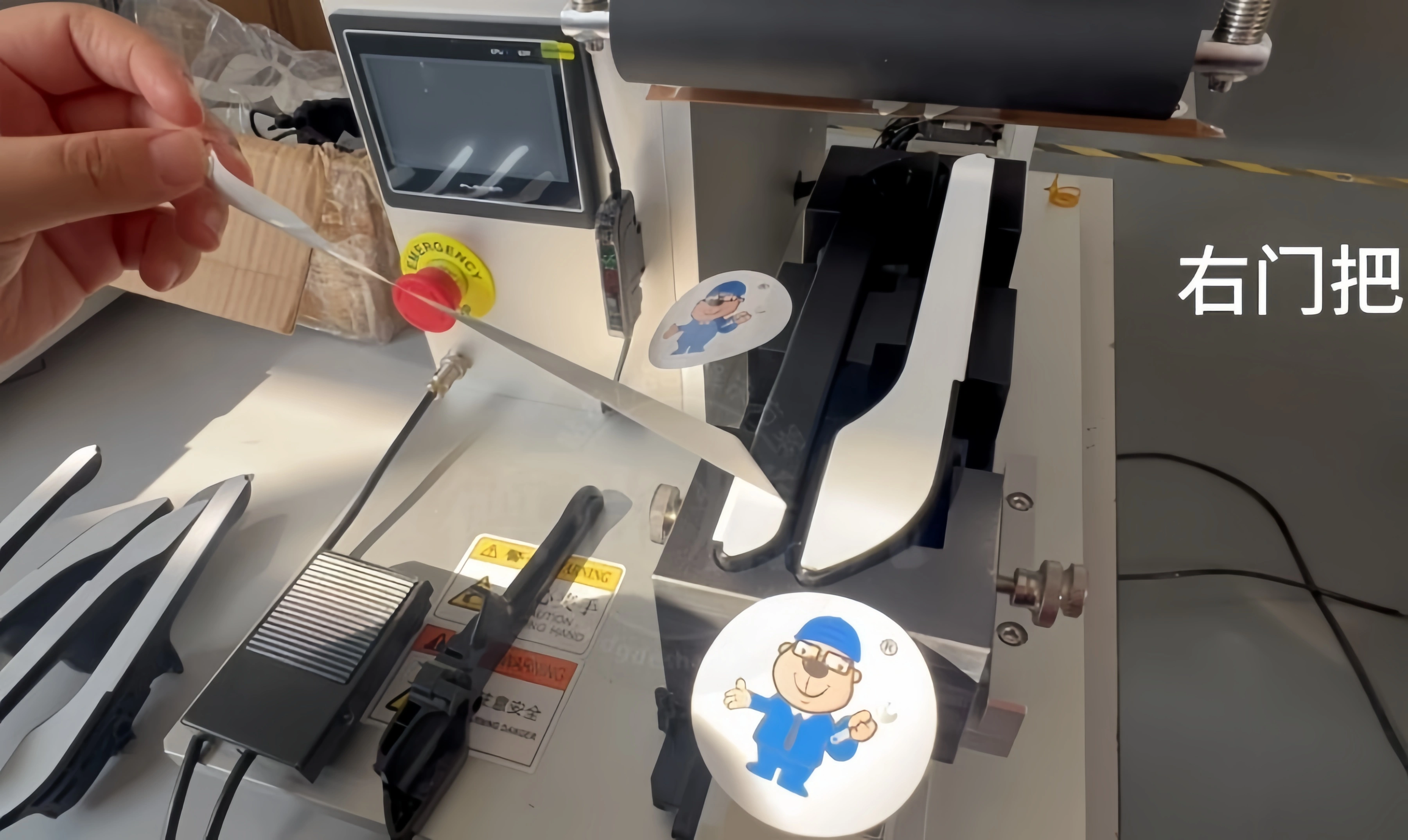
The DS-305A automotive door handles laminating machine runs PE, PVC, PET, OPP, UV, FPC and PO films plus adhesive labels, with film lengths of 20 to 200 mm and carrier widths of 20 to 160 mm. Exposed handle covers fit inside that window as single-piece films.
How to check: read your drawing's film length and carrier width against the machine window, then send the roll you will actually run, not a supplier substitute.
Check 3: Location comes from the fixture, not the operator's hand
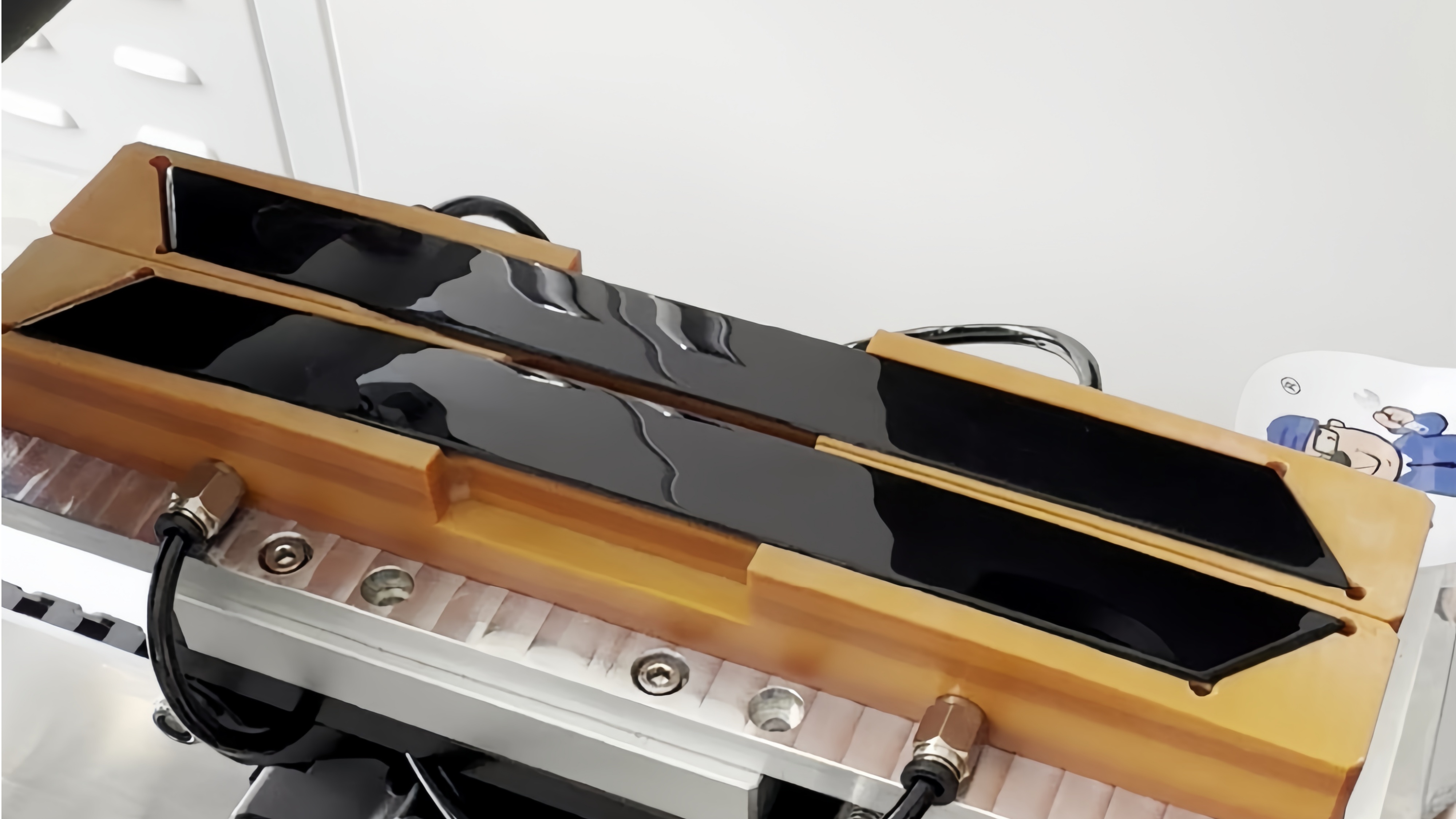
A semi-automatic machine quotes placement accuracy of plus or minus 0.2 mm, but the figure holds only when the part cannot move in its seat. Handle covers carry clip bosses and ribs on the back, so the fixture must clear them and open a film window on the face.
Whether the fixture is developed per part decides if 0.2 mm is a brochure number or a production fact.
How to check: ask who builds the fixture and from what. DawnShine machines its own fixtures on in-house CNC from your physical part, which is also why the trial starts with real samples.
Check 4: Output must be stated with its conditions
One operator loads and unloads a semi-automatic machine, and the DS-305A is rated at 600 to 1,200 pieces per hour depending on operator skill and film size. A quotation that carries one bare number without conditions is the start of a post-delivery argument.
Work backwards from molding: if the press outputs 300 parts an hour, a machine holding its 600 per hour floor covers it with margin. If two part numbers share the cell, add changeover time and keep twenty percent spare.
How to check: ask the supplier to state output for your film size and your part, then verify one hour at your takt with your own operator.
Where DawnShine Answers All Four
DawnShine has built laminating equipment for 15 years, holds more than 50 patents and works to ISO 9001. The build shop runs its own CNC machining, so fixtures and special tooling are made in house rather than subcontracted.
For door handle covers and similar molded cosmetic parts, the door handle film laminating machine we quote is the DS-305A semi-automatic film laminating machine, a benchtop roll-application unit. Each check maps to a specification line:
|
Check
|
What the DS-305A does
|
|
Follows the arc
|
Roll application for flat, gently curved and small cylindrical surfaces; air exits ahead of the contact line
|
|
Covers the film deck
|
PE / PVC / PET / OPP / UV / FPC / PO films and adhesive labels; film length 20 to 200 mm, carrier width 20 to 160 mm
|
|
Locates the part
|
Placement accuracy of plus or minus 0.2 mm on a fixture machined in house from your physical part
|
|
States output honestly
|
600 to 1,200 pcs per hour, quoted against operator skill and film size, rechecked against your part before ordering
|
Standard DS-305A specification lines. Special requirements are built to the part, subject to the sample run.
Standard DS-305A Specification
|
Parameter
|
Value
|
|
Model
|
DS-305A semi-automatic high-precision film laminating machine, benchtop roll type
|
|
Film types
|
PE, PVC, PET, OPP, UV, FPC, PO films, adhesive labels
|
|
Film size
|
Length 20 to 200 mm, carrier width 20 to 160 mm
|
|
Placement accuracy
|
Plus or minus 0.2 mm
|
|
Output
|
600 to 1,200 pcs per hour, depending on operator skill and film size
|
|
Power
|
220 V, 50 Hz, 0.23 kW
|
|
Air supply
|
0.4 to 0.6 MPa
|
|
Size and weight
|
700 x 490 x 750 mm, about 75 kg
|
Benchtop frame, 75 kg, moves between workstations. A new part number means a new fixture, not a second machine.
What Changes on Your Line
The value sits in four things that stop happening once the process is stable.
● Bubble rejects stop swinging with the shift. Roll application moves air out ahead of the contact line, so bubble rate stops tracking operator mood and becomes a process variable quality can actually manage.
● Film edges land in the same place every time. Placement accuracy of 0.2 mm on a locating fixture means one part number looks like one part, and a left-and-right pair no longer shows a visible offset.
● The post-molding cell stops backing up. A 600-per-hour floor doubles the molding takt with margin, and the two workers on hand application move to packing or inspection.
● A new handle number is tooling, not a second machine. The benchtop frame and 75 kg weight let the machine move between cells, and a new part number is a fixture and a program call.
Exposed and Hidden Handles: Where the Standard Machine Stops
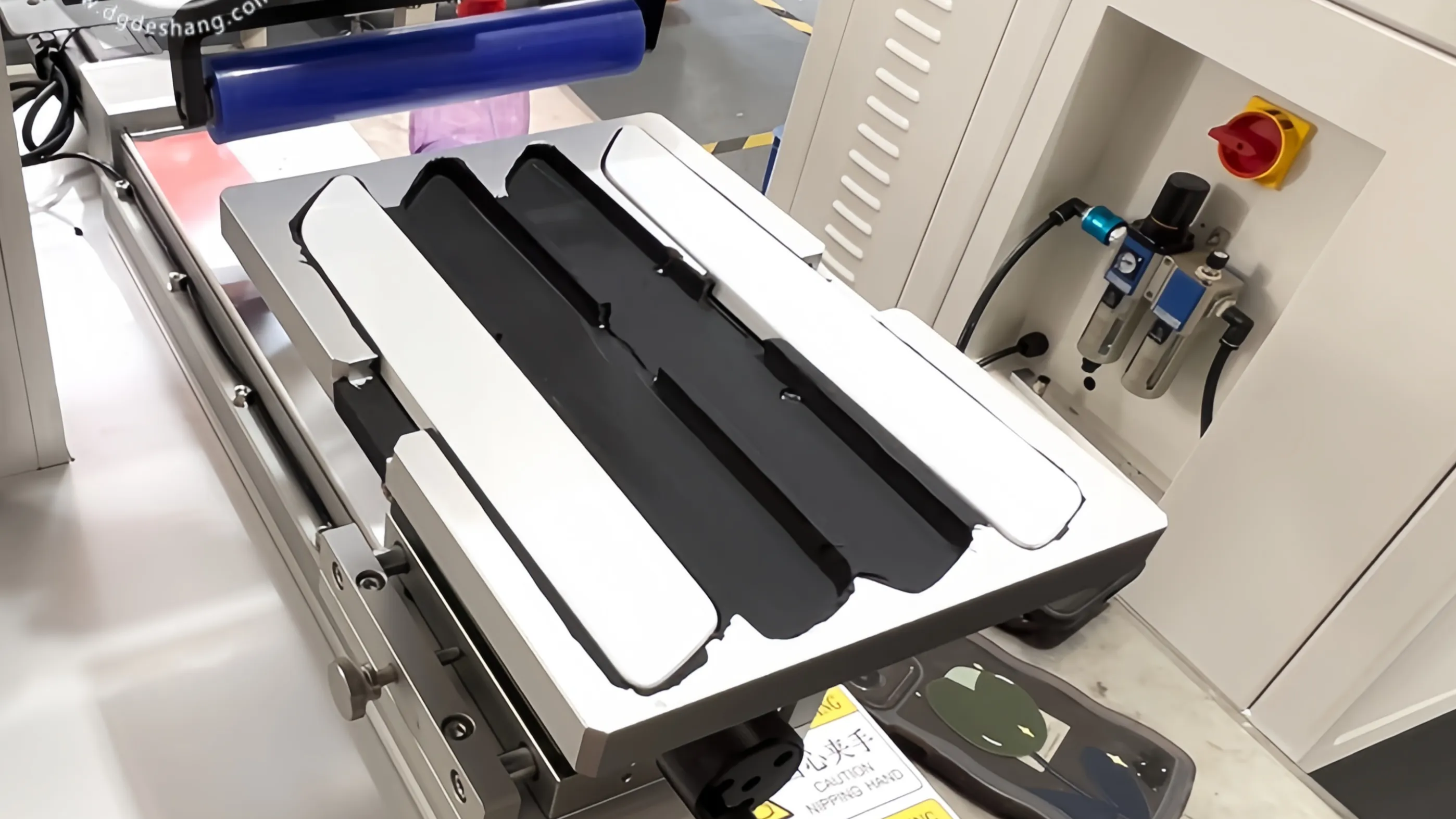
As an exposed door handle film application machine, the DS-305A covers the flat and gently curved covers directly from the standard specification.
Hidden handles are different. If the film runs the full length in one piece, it can exceed the 200 mm standard window, and a strongly curved body needs the roller verified on a sample. Trial first: send the part, run it, and let the result decide whether a standard fixture is enough.
One more boundary. This machine applies surface protective film. It is not an optical bonding unit, and if your handle program also includes VHB tape or foam, those run through different heads and are quoted as separate items.
Send Three Handle Parts
Arc, film, fixture and takt: one real part verifies all four at once. Before you commit to any door handle film laminating machine, send three covers from your production line, including the worst warp you would still accept, the roll you will actually run, and your target takt.
We run them on a DS-305A and report measured edge offset, bubble count under raking light, and cycle time per part.
Contact DawnShine to arrange a sample trial or request a quotation for your door handle parts.
Frequently Asked Questions
Can one DS-305A run both exposed and hidden handle parts?
Yes, on one machine, as long as each part's film fits the 20 to 200 mm length and 20 to 160 mm carrier width window. Each part number gets its own fixture, so changeover is a fixture swap. A hidden handle longer than the window needs a trial and possibly custom tooling.
How is the 600 to 1,200 pieces per hour figure measured?
It is the standard machine's output range under skilled operation; smaller films run closer to the top. The figure includes manual loading by one operator, so run one hour with your own operator and film before writing it into your production plan.
What if my film is wider than 160 mm?
The standard window is 20 to 160 mm carrier width. Parts beyond it start with a sample run, and confirmed projects are quoted as tooling variations on the same platform, not as a different machine.
How long does fixture development take, and is changeover difficult?
Fixtures are designed from your physical part and machined in DawnShine's own CNC shop. One fixture per part number, and changeover means swapping the fixture and calling the stored parameters; the machine itself does not change.



.jpg)
.jpg?imageView2/1/w/64/h/64/format/webp)